'We were teaching masking': Catherine Leggett on autism, culture and what employers still get wrong
Catherine Leggett, founder of Aûtentic, on autistic culture, universal design, the Workplace Reasonable Adjustments Passport, and what genuinely inclusive recruitment looks like
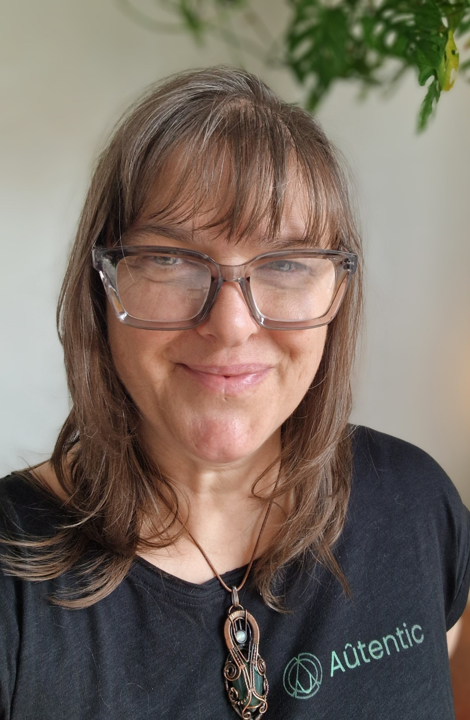
Catherine Leggett has spent more than a decade trying to change how UK employers think about autism. As founder of Aûtentic, an autism consultancy and training organisation based in Wales, they work with organisations to embed what they call affirming, culture-based approaches to inclusion — ones that begin with accepting autistic culture as legitimate, not as something to be managed or corrected.
The name Aûtentic is deliberate. It is the Romanian word for 'authentic', a reference to Catherine's own identity as an autistic person and to the organisation's founding philosophy: that autistic people should be able to be themselves at work, not a performance of someone else's expectations.
Catherine spoke to Neurodivergent Works about where employer practice is still falling short, why universal design matters more than individual adjustments and what a genuinely autism-inclusive recruitment process would actually look like.
From employability courses to employer consultancy
Catherine began their autism career in 2014 delivering job clubs through the Department for Work and Pensions' Fit for Work scheme, before moving on to design employability courses for autistic people at the National Autistic Society. The shift in focus — from supporting individuals to working with employers — came from a clear-eyed recognition of scale.
'Even then, there are limits and boundaries,' they reflect. 'In a year, I can support maybe 50 or 60 autistic people, when there are hundreds of thousands that need support in work.'
But the shift was also driven by what Catherine was seeing in those individual cases. The majority of situations they were called into as a specialist — often after Access to Work assessments had been exhausted and the employer had tried everything they could think of — had begun the same way.
'The majority of those cases started with a social misunderstanding. Not on behalf of the autistic person, but on behalf of their team, HR, their manager — that had really gone uncontrolled, with no understanding, no compassion, no training.'
What struck Catherine most was the nature of the interventions being attempted. Early in their career, employability courses were effectively teaching masking — helping autistic people navigate social expectations that had been designed for neurotypical employees.
'When I started working in this industry, we were teaching masking, essentially. For example: "When we want to show people that we're friendly, we smile."'
Catherine rewrote the content. The courses became something closer to a self-defence toolkit — focused on self-advocacy, boundary-setting and communicating needs effectively. But the fundamental problem remained: changing the individual rather than the environment.
'If you can change an autistic person from someone who, from a neurotypical point of view, will say inappropriate things but not unacceptable ones — well, then essentially that person wouldn't be autistic. And if you do manage to get that message through to the person, what you're asking them to do is to mask. Which directly correlates to the poorest mental health outcomes for that part of the autistic community, which is serious.'
What HR teams still get wrong
The misconceptions Catherine encountered in their early career were, at least, relatively straightforward to name. HR teams often believed autistic people lacked empathy — a claim Catherine dismisses.
'There's so much really robust empirical evidence out there to show that many autistic people without an intellectual disability are actually hyper-empathetic and very sensitive.'
The more common approach was to focus on changing the individual: coaching, counselling, therapy aimed at helping autistic employees become more resilient in neurotypical environments. That, too, has shifted.
'I think that's changing. I'm going to say it can go to the other extreme. And it's usually a line manager, but sometimes somebody in HR, who has removed every single professional boundary and guide for the person — and sometimes that's not helpful either.'
What Catherine sees now is a different kind of problem. HR departments are overwhelmed with requests for reasonable adjustments, as neurodivergent employees have become more confident in advocating for themselves — a development they attribute in part to the visibility of ADHD communities online. But the response from employers is often individualised firefighting rather than structural change.
'My main point I want to get through to employers is: if somebody is asking you for a reasonable adjustment, it's probably something you should be doing as standard as part of your universal design. If somebody is asking in a meeting for written notes and a summary, because they cannot follow along — that's something you should just introduce as standard. Because there is not just going to be one person asking for that, and there will be many, many more that aren't confident enough to ask.'
The principle Catherine returns to consistently is universal design: building inclusion into processes from the outset rather than retrofitting adjustments when individuals request them.
The Workplace Reasonable Adjustments Passport
One of Aûtentic's practical tools is the Workplace Reasonable Adjustments Passport — a structured document that gives employees a way to record their support needs, adjustment history and communication preferences in a portable, transferable format.
The impetus came from a pattern Catherine kept encountering in consultancy work. An autistic employee would be thriving under a manager who instinctively understood their needs — and then that manager would leave. The successor would know nothing. All the adjustments, all the understanding, all the accumulated knowledge of how to support that person evaporated.
'There was a manager in place who just got it, just absolutely got everything about that person. Was able to just make changes for them, supported them, understood them — and the person was thriving. And then the manager leaves, gets promoted, goes through a different organisation, or maybe leaves through illness or retirement. And by the time a new manager comes in place, all of those brilliant things that the previous manager did weren't documented in any way.'
The passport addresses that problem directly. It is structured to share different levels of information with different people — the team, the line manager, HR — based on sensitivity. The team needs to know what they can do day-to-day in every interaction. The line manager needs to understand the signs that someone is becoming overwhelmed.
Catherine also designed it to address the confidentiality confusion that frequently derails disclosure. It is common, they explain, for an autistic employee to disclose to HR at the recruitment stage — and then assume that information has been passed to their line manager, who in fact has no idea.
'Lots of line managers I've supported throughout my career have been going from square one, not even knowing that the person has a diagnosis. And the person has just assumed the information has been shared.'
The passport makes the decision-making process around sharing information explicit. It also gives employers structured guidance on what a reasonable adjustment is, how to assess whether one is appropriate, and what escalation looks like if a request is refused.
'There are organisations that will say: "Oh, well, we've got an open culture, people can speak to their line managers." And I'll say: "Well, that's great, but we need to put structure in for autistic people." These are hard things to ask for. Let's get a written way to do that.'
Lived experience and what is lost without it
Catherine is direct about the role their own experience plays in their work. For around a decade before they began working in this field, they spent years trying to change themselves — attending Reiki sessions to address touch aversion, masking intensively, experiencing serious mental health difficulties.
'My mental health was shocking. Absolutely shocking. I take good care of it now, but there are a lot of scars left from those days.'
That history, combined with intensive one-to-one work supporting hundreds of autistic people through workplace assessments, has produced what Catherine describes as a kind of intuition — an instinct for what will actually help that they believe is difficult to replicate without lived experience.
'There will always be a point at which I wonder about their neurotype. They'll say they're not autistic, and then I will wonder, because there is such an insight and such an intuition.'
Non-autistic practitioners can be excellent, Catherine says — but the risk, when autism consultancy is led by people without lived experience, is that they make assumptions without asking.
'When non-autistic people assume, without even talking to the person, what will be best for that person — we're in real trouble.'
Autism-specific or neuroinclusion frameworks?
Catherine is candid about their bias. They specialise in autism, and they are clear about why.
'I am biased towards autistic people and supporting autistic people. I'm autistic, not least, and have had many of the same experiences that the people I support have who are in real trouble.'
The reason autism requires specific attention, in their view, is the social and cultural gap. Autistic people have their own social culture — one that is legitimate and valid, not deficient — but one that diverges significantly from neurotypical norms. That gap is still, Catherine says, the primary driver of autistic people being pushed out of employment or unable to enter it.
'I see lots of brilliant neuroinclusion frameworks and work going on, and nowhere in there is mention of autistic culture and that social difference. Which is often our biggest problem in the workplace — still from when I started doing this work, and still the reason why we're driven out or can't get into employment in the first place.'
That is not an argument against neuroinclusion frameworks. Catherine supports thinking in terms of broader categories — attention needs, sensory needs, working memory, object permanence — rather than condition labels alone. But they are firm that autism-specific practice must be part of the picture, not subsumed by it.
What genuinely inclusive recruitment looks like
The barriers to autistic employment begin, Catherine argues, before a candidate has even submitted an application. Job adverts routinely include desirable criteria alongside essential ones — and many autistic candidates will not apply unless they meet every criterion listed.
'Employers should think really carefully about what constitutes essential criteria. Desirable or advantageous criteria can be difficult for lots of autistic people to think about — they often won't apply for a job if they don't meet all of both essential and desirable criteria.'
Catherine is also sharply critical of video application tools — platforms such as HireVue that require candidates to submit recorded clips of themselves speaking.
'I have worked with employers that have required candidates to submit a short video clip of them talking about their skills, and they have positively screened in candidates with sophisticated neurotypical communication. That is discriminating against autistic candidates.'
Psychometric testing, too, carries legal risk. Catherine cites a tribunal case in which a graduate applicant to the civil service requested an alternative to psychometric testing. The tribunal found the employer had discriminated against her by failing to provide one.
What Catherine advocates instead is a two-stage process: a carefully designed application or blind CV selection stage, followed by a practical job trial or work activity that allows candidates to demonstrate what they can do rather than describe it.
'I believe in my soul and my very being that that is the only way to get the best candidate for the job and remove all barriers. Employers have told me that a person performed extremely well in a verbal interview but was really struggling in the role. If you design a job activity that someone can complete to show you what they can do — that suits everybody.'
But recruitment, Catherine insists, is only the beginning. Hiring autistic people into environments that cannot support them is damaging in ways that go beyond professional failure.
'There is no point in recruiting autistic people if they are not then properly supported when they are in the role. The damage it does to people — to successfully get work, meaningful work, and then have to leave that role and try again and get into that cycle — is really significant. So if you can't support employees properly when they're in, don't do that work.'
For more information
Aûtentic's resources for employers
Aûtentic's resources for autistic people
Subscribe for free to receive practical guidance on neurodiversity at work, delivered to your inbox