The first UK trade publication for workplace neurodiversity

'Take the lanyard off your soul': HR After Hours panel calls time on tick-box neuroinclusion

Noise-cancelling headphones, superpower narratives and the phrase 'everyone's a bit like that' all came under fire as a panel of neurodivergent speakers told a Bristol audience of HR professionals that inclusion must be built into workplace systems, not bolted on
'Take the lanyard off your soul': HR After Hours panel calls time on tick-box neuroinclusion
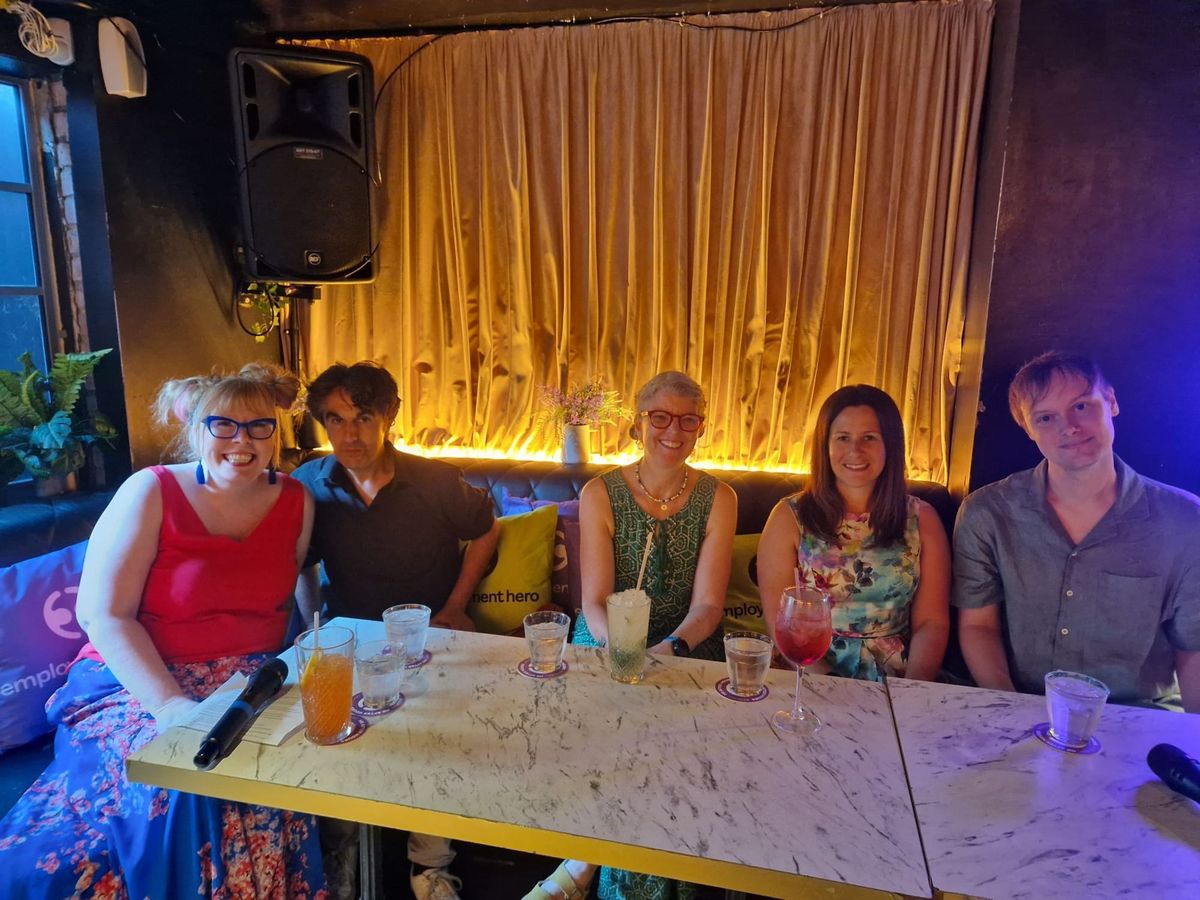
l-r Michelle Hartley, Alex Beeching, Sarah West, Hayley Brackley, Tom Daldry

HR professionals from as far afield as Scotland and Manchester gathered in Bristol on 9 July for the HR After Hours Summer Social, hosted by Michelle Hartley of People Sorted and the HR Geek Squad in partnership with Employment Hero.

The panel discussion, themed around the idea that one size does not fit all, brought together Hayley Brackley, neurodiversity specialist and author of The Seven Lenses: A New Way to Look at Neuroinclusion; Sarah West, ADHD and perimenopause coach at ADHD Thrive Together; Alex Beeching, writer, speaker and self-described 'unbeige ideas machine'; and Tom Daldry, editor of this publication, Neurodivergent Works.

Hartley, who chairs the HR After Hours series and founded The Great Geek Together conference, said neurodiversity was 'the one topic that we never really do justice' at HR events, and framed the evening as a chance to change that.

Phrases to ban

Hartley opened by asking the panel which workplace phrase they would ban forever on the grounds that it stops people asking for support.

Brackley nominated 'feedback is a gift', comparing unwanted feedback to an unwanted perfume set: 'For the majority of us, we don't want feedback. It's the Just Pink without a gift receipt.'

Daldry chose the claim that in-office working is essential for collaboration and creativity. 'That phrase can make neurodivergent people feel like they can't request reasonable adjustments for hybrid or remote working,' he said. 'If an organisation has embedded "come to the office two or three days a week" into their culture, it's not helpful for a lot of neurodivergent people.'

West took aim at 'everyone's a bit like that', drawing on her experience of rejection sensitive dysphoria (RSD), a visceral emotional response to real or perceived rejection that she described as one of the most painful aspects of ADHD. 'To have the courage to say to somebody "I think I've got ADHD", and you're immediately told everyone's a bit like that? This significantly impacts people's lives,' she said, adding that the same applied to the 'superpower' narrative, which downplays the condition's genuine difficulties.

Beeching agreed, noting that the superpower framing erases the costs of neurodivergence: 'When was the last time you saw a Marvel film with Mr Anxiety, or Doctor Imposter Syndrome? I know it is a superpower, but equally it can be a curse.'

The biggest lie about inclusion

Asked what the biggest lie is that organisations tell themselves about inclusion and flexibility, West answered: 'That they know what it is.' She argued that employers hold fixed views of flexibility that fail to reflect how neurodivergence actually shows up in people's lives, particularly for women navigating perimenopause, whose hormonal changes can dramatically intensify ADHD symptoms. 'You've really got to listen to people rather than having a boss tell you what you need. It's never one case fits all, ever.'

Brackley said the lie was treating inclusion as one person's job or a standalone project. 'You can't have one person doing inclusion. It's got to be built into the systems that we operate in,' she said, criticising the tendency to hand unpaid employee resource group work to the very people already struggling with unfair systems.

Beeching, drawing on a career in advertising, said inclusion 'needs to go through the organisation like a stick of rock'. He described employers who celebrate difference only up to a point: 'We celebrate difference in our organisation. Until that difference is too different.'

'I don't want special treatment'

Hartley asked the panel what employees really mean when they say they don't want special treatment.

'People don't want to be seen as a problem for their employer. They want to stay under the radar,' said Daldry. He added that many people, particularly those diagnosed later in life, do not recognise their neurodivergence as a disability that actively disadvantages them at work. 'If you're able to mask your way through and hold down a job, there can be an internal sense of "well, I can't be that disabled, can I?"'

Brackley said the phrase often means 'I don't want to be singled out' and placed on 'a toxic pedestal' where colleagues resent visible accommodations. For someone who experiences emotions with greater intensity, she said, feeling resented by colleagues 'blows out of the water any of the reasonable adjustments that might have been helping you'.

From reasonable adjustments to effective working conditions

The liveliest exchange came when Hartley proposed retiring the term 'reasonable adjustments' altogether in favour of 'effective working conditions'.

Brackley described the current process as clunky and adversarial: employees must disclose, argue their case, navigate occupational health and managers pulling in opposite directions, and too often end up with a token gesture. 'Imagine if we ditched the principle that this one thing magically fits everything, and instead said: what do you need to come here, have a great day, be productive, be well, be happy, be safe?'

She also made the business case, noting that the average adjustment costs around £75. 'If somebody's on minimum wage, that's one day's wages, and if across the year you get 10% more productivity, how marvellous is that?'

Daldry agreed, taking issue with the language itself. 'Reasonable suggests there's a spectrum of what can be asked for. When does reasonable become unreasonable? "Effective working conditions" is a lot more positive. It's about fostering productivity rather than patching up someone's disability.'

Safety signals

On what signals tell employees it is safe to speak up, West said people watch how colleagues who disclosed before them were treated, recalling workplaces where she 'said nothing' after seeing others mocked and pushed out. Safety, she said, comes down to trust and being believed, 'even if they don't actually understand you'.

Beeching said the answer was empathy: 'You simply want to be treated as a human, not as a label, not as a box to be ticked. Take the lanyard off your soul and speak to each other as equals.' Hartley immediately declared she was stealing the phrase.

Closing the panel, Hartley asked each speaker for one change the audience could make tomorrow.

Daldry pointed to psychological safety as the foundation, suggesting employers use internal communications to remind staff that adjustments are part of employment law: 'It gives huge psychological security to know that you're immediately protected.'

Brackley warned against surface-level fixes, invoking the culture iceberg: policies, passports and posters above the waterline mean nothing if eye-rolling managers and diagnosis-demanding leaders lurk beneath. Neurodivergent employees, she noted, are often expert pattern-matchers of human behaviour: 'What we've got is a perfect bullshit radar.' Her prescription was a full cultural audit rather than 'an easy tick box'.

West urged employers to stop prescribing: 'Rather than saying to people "this is what you need", say "what could we do that would help you?"'

Beeching told the audience to carry a 'bullshitometer' and to remember that neurodiversity 'isn't a bug to fix'. Adjustments, he argued, are both a moral and a business imperative: 'They will make the person feel better, and they will make your business better. So do it.'

Subscribe for free to receive practical guidance on neurodiversity at work, delivered to your inbox.

Subscribe for free

Proud media partner of

The Great Geek Together